


One-stop Air Classifying Mill Factory in China
JB series mini-efficient pulverizer (air classifying mill), also called air classifier mill or air classification mill, consists of three parts: the main machine, the auxiliary machine, and the electric control box. It has the characteristics of wind selection, no sieve or net, and an even granularity of the processed material. The production process goes on continuously, and the machine can undertake grinding of chemical products, foodstuffs, cosmetics, plastic, dyestuffs, resin, grain, etc.
Baoli Machinery is one of the best air-classifying mill manufacturers & suppliers in China. If you are looking for an air classifier mill, you can contact us!
-
![Dry Leaf Pulverizer Machine]() Add to Inquiry
Add to Inquiry -
![Ultra Fine Powder Grinder]() Add to Inquiry
Add to Inquiry -
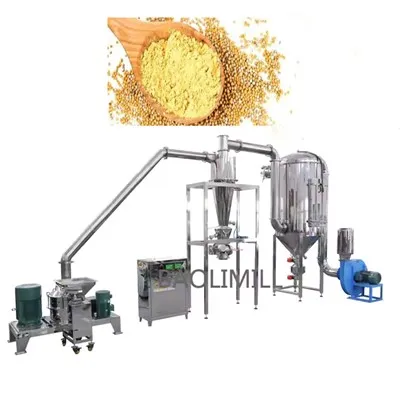
![Mungbean Powder Superfine Powder Pulverizer]()
Mungbean Powder Superfine Powder Pulverizer
Add to Inquiry -
![Cassia Leaves Pulverizer Machine]()
Cassia Leaves Pulverizer Machine
Add to Inquiry -
![Dried Lemon Peel Powder Grinding Machine]()
Dried Lemon Peel Powder Grinding Machine
Add to Inquiry -
![Ultrafine Amchur Powder Pulverizer Machine]()
Ultrafine Amchur Powder Pulverizer Machine
Add to Inquiry -
![Super Fine Oat Grinding Machine]()
Super Fine Oat Grinding Machine
Add to Inquiry -
![300 Mesh Clove Leaf Powder Grinding Machine]()
300 Mesh Clove Leaf Powder Grinding Machine
Add to Inquiry -
![Fajita Seasoning Powder Pulverizer Machine]()
Fajita Seasoning Powder Pulverizer Machine
Add to Inquiry -
![Yellow Mustard Seed Grinding Machine]()
Yellow Mustard Seed Grinding Machine
Add to Inquiry -
![Wet Glutinous Rice Powder Grinding Machine]()
Wet Glutinous Rice Powder Grinding Machine
Add to Inquiry -
![Moringa Leaf Pulverizer Machine]()
Moringa Leaf Pulverizer Machine
Add to Inquiry




Air Classifying Mill Working Principle
The material enters the grinding chamber via the funnel and spiral conveyor where it is sheared and broken by the fastrotating blades. The power passes the guide ring and enters the classification chamber. As the classification wheel is in revolution, both the air force and centrifugal force act on the powder.
As the particles whose diameters are greater than the critical diameter (diameter of the classification particles) have a great mass, they are thrown back into the grinding chamber to be ground again, while the particles whose diameters are smaller than the critical diameter enter the cyclone separator and bag type collector via the material exit pipe using negative pressure wind conveyance. The discharge material meets the requirements for the product.

Structure of Air Classifier Mill
Grinding Chamber: This is where the material is initially fed in. It is equipped with grinding elements such as rollers or hammers. These elements break down the incoming material into smaller particles by applying mechanical force through methods like impact and compression.
Classification Zone: Located above the grinding chamber, it contains a set of classifier wheels or vanes. The classifier wheels rotate at high speeds, creating an air current that separates the ground material based on particle size.
Air Inlet and Outlet: The air inlet supplies air into the mill, which forms the air current for classification and also helps in cooling and transporting the material. The air outlet is used to discharge the air along with the finely ground and classified material.

Advantages of Our Air Classification Mill
Dual Functionality
Combines grinding and classification in one machine, eliminating the need for separate equipment.
Precision Control
Allows precise control over particle size distribution by adjusting the classifier speed and airflow.
High Efficiency
Reduces energy consumption by avoiding over-grinding of fine particles.
Compact Design
Saves space compared to traditional grinding and classification systems.
Applications of Air Classifying Mill
BAOLI air classifying mill is a highly efficient and precise grinding solution for industries requiring fine and ultra-fine powders with tight particle size control. The production process goes on continuously and can undertake grinding of chemical products, foodstuff, cosmetics, plastic, dyestuff, resin, grain, etc.


Pharmaceutical Industry: It is used to grind and classify pharmaceutical powders to ensure precise particle size distribution, which is crucial for the efficacy and solubility of drugs.
Food Industry: In the production of flour, spices, and other food products, air classifying mills are employed to achieve the desired fineness and uniformity of the particles.
Chemical Industry: They are used to process chemical raw materials and pigments, enabling the production of fine powders with consistent particle size, which is essential for ensuring product quality and performance in applications like coatings and plastics.
Mineral Processing: For processing minerals like limestone, talc, and kaolin, air classifying mills help in obtaining high-quality mineral powders with specific particle size ranges for various applications such as in construction materials and ceramics.
Cosmetics: Creating ultra-fine powders for makeup and skincare products.
